

A commercial VR motion simulator combines virtual content with physical movement. Choose one by its movement type, guest capacity, operating envelope and service requirements. Seat count and dramatic ride footage are useful starting points, but neither tells you whether the equipment fits your venue.
A two-seat rotating attraction and a six-seat tilting cinema solve different operating problems. This guide compares those differences and shows how to turn them into a shortlist for an arcade, family entertainment center or VR park.
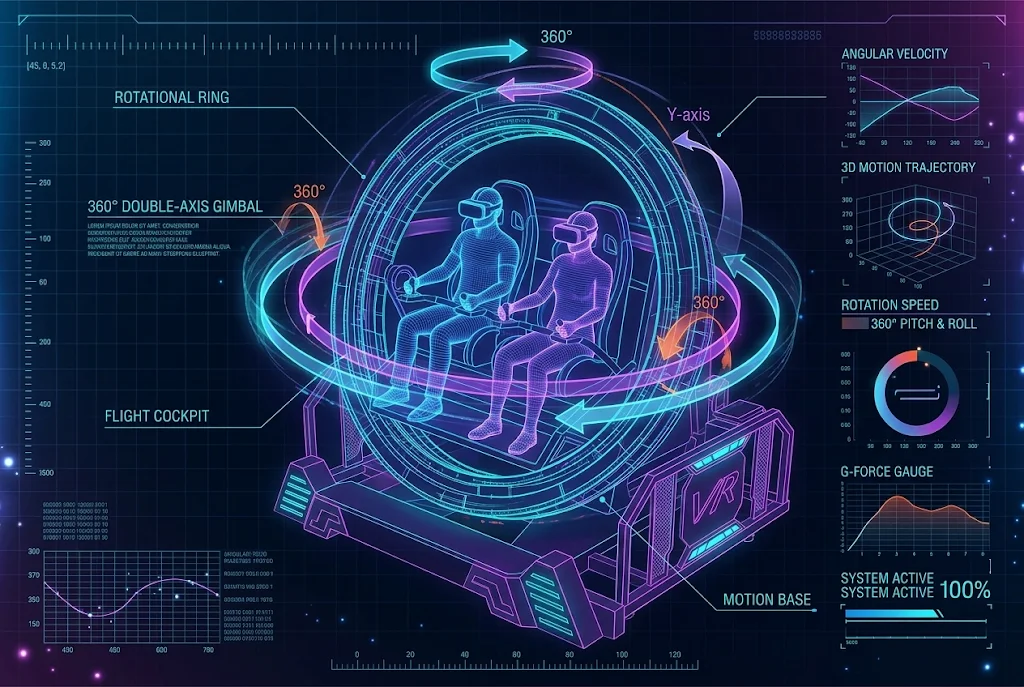
Identify the movement before comparing the name
Terms such as motion ride simulator cover several mechanisms. Ask the supplier to describe what physically moves, the direction and range of movement, and how it follows the content. Marketing labels alone do not answer those questions.
- Tilting platforms: Change the orientation of a seat or group of seats. Evaluate the actual movement and how each guest experiences the shared platform.
- Rotating rides: Can move riders through a much larger rotational path. Evaluate the complete moving envelope, boarding procedure and documented stopping and recovery process.
- Lift-based attractions: Add vertical movement to the experience. Check the full operating height and access requirements, not only the parked machine dimensions.
A degree-of-freedom specification describes independent movement axes; it is not a universal ranking of ride quality. Ask for the actual mechanism and a demonstration rather than assuming a larger number suits every audience.

Use real models to compare operating roles
The Double 360 VR Flight Simulator, Dark Mars 6-Seat VR Simulator and VR Shooting Mecha provide different examples. The table separates published features from the operating questions buyers should investigate.
| Model | Published capacity and movement | Operating question |
|---|---|---|
| Double 360 VR Flight Simulator | Two players; full rotation with wind and vibration | Can staff manage boarding and recovery while keeping the movement envelope clear? |
| Dark Mars 6-Seat VR Simulator | Six players; synchronized tilt with wind and vibration | How will the venue form groups, fit headsets and manage partially filled sessions? |
| VR Shooting Mecha | One player; vertical lift with shooting controls | Does the operating position allow assistance and a clear view of the rider? |
Published specifications add scale to this comparison. Double 360 lists 2,830 × 2,600 × 2,060 mm, 220 V and 3 kW. Dark Mars lists 3.68 × 2.27 × 2.17 m, 220 V and 3 kW. VR Shooting Mecha lists 2,125 × 1,620 × 2,274 mm, 220 V and 1.75 kW. These are product-page figures, not moving envelopes or complete electrical designs; request current model drawings and installation documents.
Obtain the current configuration and operating documents for the exact unit being quoted.
Separate seat capacity from practical guest capacity
A larger seat count creates more available places per cycle. It does not guarantee that those places will be filled or that boarding will take the same time as on a smaller attraction.
Compare three records from a demonstration: the complete cycle time, the number of occupied seats and the staff time required. The cycle includes assistance, fitting, play, unloading and reset. For group equipment, decide whether you will start promptly with vacant places or wait for another group.
Observed guest rate = total completed guest rides ÷ observed operating hours. Record downtime and quiet periods separately.
For a venue serving mixed party sizes, examine how the attraction handles a solo guest, a pair and a larger party. Ask which seating arrangements are permitted; never assume a motion machine can operate with any seat-loading pattern.
Check the moving envelope and delivery route
The listed length, width and height describe a product, but installation planning also needs its moving envelope, boarding space, operator position and maintenance access. A rotating component may require space that is not obvious in a front-view photograph.
Request drawings showing both operating and parked conditions. Separately verify crate dimensions, unloading arrangements, doorway restrictions and the route to the final position. A machine that fits the room may still be difficult to deliver into it.
Use the venue floor plan guide to coordinate circulation around the selected ride. The installer should review the actual model and site before equipment positions are finalized.
The UK racing party club case illustrates a group VR attraction within a mixed entertainment venue; it does not establish operating clearances for another site.
Evaluate maintenance access during selection
Ask to see how staff reach routine service points and replace wear items. A visually impressive enclosure can still be inconvenient if routine tasks require moving adjacent equipment. Confirm which checks the operator performs and which require a qualified technician.
- Request the inspection schedule and the tasks required before daily operation.
- Identify consumables, replaceable headset components and model-specific spare parts.
- Ask how a fault is recorded and what information technical support needs.
- Clarify remote support, on-site work, spare-part shipping and warranty exclusions.
- Include the approved shutdown and recovery procedures in staff training.
Match intensity to the guests you can serve
Choose content and movement appropriate to your target visitors within the manufacturer’s eligibility rules. A family venue does not automatically need the most intense movement available. Ask whether selectable experiences change the motion profile and have the supplier demonstrate the options.
Do not promise that an attraction is suitable for every age or that it cannot cause discomfort. Staff need clear eligibility guidance and an established response when a guest wants to stop.
Frequently asked questions
Is a six-seat motion simulator always better for throughput?
It offers more simultaneous places than a smaller model, but actual throughput also depends on occupancy, loading, headset fitting and reset time. Compare complete operating cycles and realistic group sizes.
Does a 360-degree ride replace a tilting VR cinema?
Not necessarily. The movement, seating and guest experience differ. Compare the role each attraction would serve and the operating requirements your venue can support.
Is a VR treadmill the same as a VR motion simulator?
A treadmill or walking interface is designed around locomotion input, while a seated motion ride physically moves the rider. The VR Treadmill Machine is a one-player walking format; its product page lists a 2 m² operating area and 1,724 × 1,415 × 1,790 mm product dimensions. Compare its operating area, assistance and maintenance requirements separately from seated rides.
Build your shortlist around the operating plan
Review the commercial VR equipment catalog and shortlist models with different roles. Share your floor plan, audience and staffing assumptions through the VR arcade planning service before comparing final quotations.
Turn your research into a venue plan.
Share your space, audience and goals for a practical equipment recommendation.
Request a proposal